For decades, talking or playing music to plants was dismissed as a charming eccentricity. But cutting-edge research in bioacoustics—the study of sound production and reception in living organisms—is proving that plants aren't just listening; they are actively responding. From opening microscopic leaf pores to physically growing toward sound sources, the acoustic environment plays a crucial role in how your garden and houseplants thrive.
The science: How plants "hear" without ears
Plants do not have ears, but they are incredibly sensitive to mechanical vibrations. Sound waves travel through the air as pressure waves, which physical structures on plants can detect:
- Mechanoreceptors: Specialized proteins in plant cell membranes that detect physical pressure, sound waves, and tactile sensations.
- Resonance of leaves: The flat, thin surfaces of leaves act like tiny drums, vibrating in response to specific sound frequencies.
- Root bioacoustics: Research has shown that plant roots can detect the sound of flowing water through soil vibrations, growing directly toward the source.
Stomata and the "Classical Music" effect
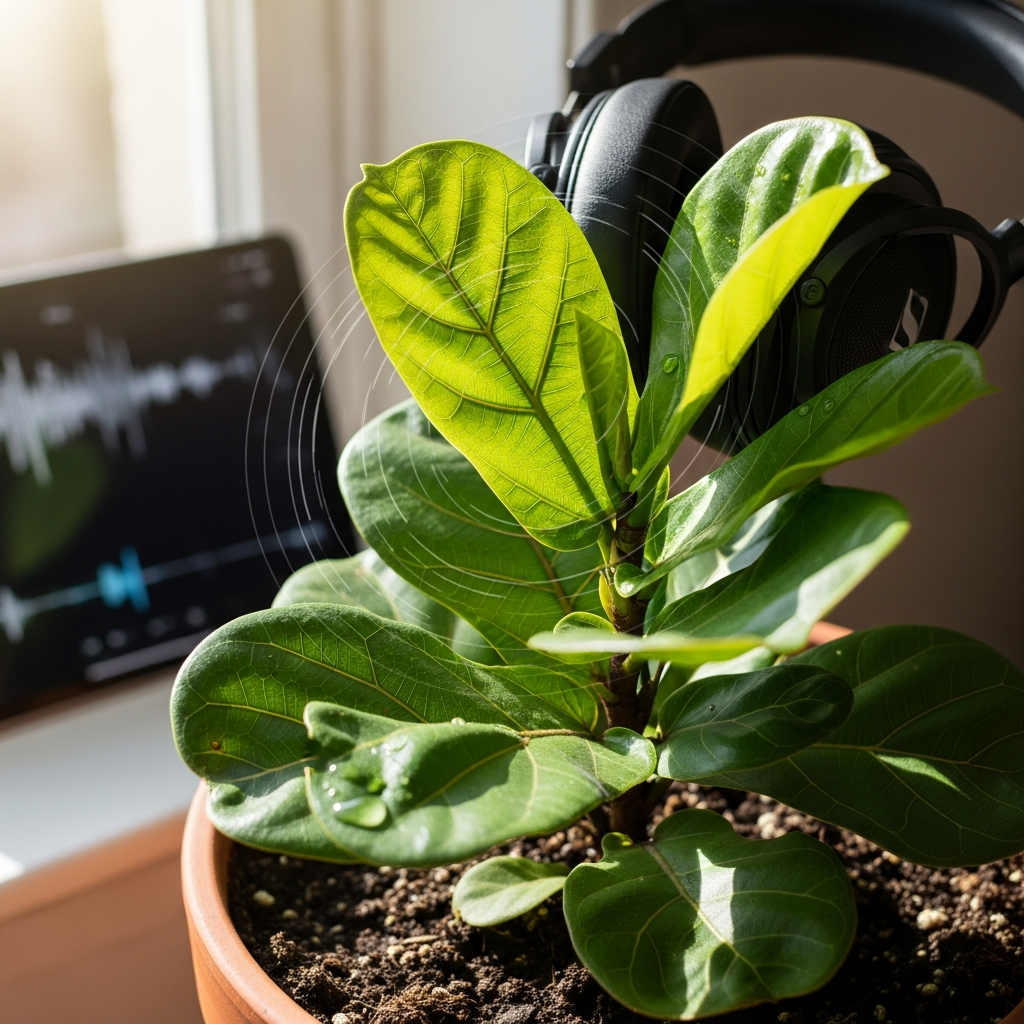
One of the most fascinating scientific discoveries is the impact of sound waves on stomata—the microscopic pores on leaves that handle gas exchange and water transpiration. When exposed to specific harmonic frequencies (such as classical music or gentle nature sounds in the range of 1 kHz to 5 kHz), plant stomata open wider.
This wider opening allows the plant to:
- Absorb carbon dioxide more efficiently.
- Speed up photosynthesis.
- Increase transpiration, drawing more nutrient-rich water up from the roots.
However, the genre matters. Studies show that chaotic, discordant sounds (like harsh static or extremely heavy metal played at high decibels) can cause stomata to slam shut, triggering a stress response and stunting growth.
How to create a playlist for your plants
If you want to try sound stimulation in your indoor jungle, here is the scientific formula for the perfect plant playlist:
1. Keep it melodic and harmonic: Classical compositions (Mozart, Bach, Vivaldi), ambient chill synth, or nature recordings (birds chirping, gentle rain) are ideal. Nature sounds are especially effective because plants evolved alongside them.
2. Mind the frequency: Aim for sounds between 1,000 Hz and 5,000 Hz. This frequency range matches natural outdoor environments and has been shown to yield the highest rates of stomatal opening.
3. Limit the sessions: Don't play music 24/7. Plants need rest just like humans. Playing music for 1 to 3 hours in the morning—when plants are naturally beginning their daily photosynthetic cycle—is the most effective routine.
Tune in with Leafy AI
As you fine-tune your plant care routine, keeping track of different variables can be a challenge. With Leafy, you can easily log when you run your acoustic sessions and monitor the effects on leaf quality, growth rate, and overall plant health.
If you spot any unexpected changes, launch a live video or voice call with Leafy’s AI expert to discuss symptoms and get real-time feedback.
Let's make gardening a multi-sensory experience. Play some classical tunes for your leafy friends and let us know what differences you see!