Ignore marketing "equivalent wattage" and raw lumens on grow-light boxes—plants count photons between 400 and 700 nm (PAR). Instantaneous intensity at the leaf surface is measured as PPFD (μmol·m−2·s−1), while total daily solar budget is Daily Light Integral (DLI = PPFD × Hours × 0.0036). Foliage tropicals thrive at 6–11 mol·m−2·d−1 DLI (120–250 PPFD for 12–14 hrs), whereas compact succulents, vegetable seedlings, and indoor citrus demand 14–28+ DLI under 3500K–5000K full-spectrum white LEDs.
Human eyes evolved to peak sharply in yellow-green wavelengths (~555 nm), making an indoor living room look comfortably bright at just 35 foot-candles (380 lux). Chlorophyll a, chlorophyll b, and carotenoid accessory pigments operate on completely different math: they harvest individual photons across the entire 400–700 nm Photosynthetically Active Radiation (PAR) band—peaking in blue (430–460 nm, driving compact internodes and stomatal opening) and deep red (640–665 nm, driving peak carbon fixation and flowering).
That perceptual gap explains the single most common heartbreak in indoor gardening: placing a Monstera Deliciosa, Echeveria, or tray of Tomato seedlings in a "bright room" 7 feet from a window—or buying a cheap purple clip-on LED—only to watch stems stretch pale and floppy from etiolation (leggy growth).
1. PPFD vs. DLI: Speedometer vs. Odometer
Horticultural lighting engineers rely on two paired metrics that remove 100% of the guesswork:
- PPFD (Photosynthetic Photon Flux Density, μmol·m−2·s−1): Think of PPFD as your light's speedometer—the exact number of micromoles of photosynthetic photons striking one square meter of leaf canopy every single second at a specific mounting distance. (For white full-spectrum LEDs or daylight, 100 Foot-Candles ≈ 1,076 Lux ≈ 18 to 20 μmol·m−2·s−1 PPFD.)
- DLI (Daily Light Integral, mol·m−2·d−1): Think of DLI as the daily fuel tank—the cumulative moles of photons delivered across the entire day, calculated via:
DLI = PPFD × Photoperiod (hours) × 0.0036.
Running a gentle 180 PPFD bar light for 14 hours delivers 9.1 DLI—enough to produce fenestrated Monstera leaves without scorching delicate foliage!
Want to estimate your window's natural Foot-Candles, Lux, and DLI right now before buying hardware? Run your window orientation and distance through our free Indoor Window Light & DLI Calculator.
2. Research-Backed PPFD & DLI Target Matrix by Plant Category
Mount your full-spectrum white LED bars or pendant bulbs to hit these canopy-level PPFD targets on a smart plug timer (always leaving 8 to 10 hours of uninterrupted darkness at night for C3 dark respiration and CAM stomatal uptake in Snake Plants and succulents):
| Plant Group & Species | Target PPFD (μmol/m²/s) | Timer Hours | Target DLI (mol/m²/d) |
|---|---|---|---|
| Shade Understory Foliage ZZ Plant, Snake Plant, Cast Iron Plant, Aglaonema |
50 – 100 μmol/m²/s | 12 hrs | 2.2 – 4.3 DLI |
| Humidity & Forest-Floor Tropicals Calathea, Prayer Plant, Boston Fern, Moth Orchid |
90 – 160 μmol/m²/s | 12 hrs | 3.9 – 6.9 DLI |
| Climbing Aroids & Blooming Foliage Monstera, Philodendron, Anthurium, Hoya |
140 – 260 μmol/m²/s | 12 – 14 hrs | 6.0 – 12.5 DLI |
| Compact Succulents & Cacti Echeveria, Jade Plant, String of Pearls, Barrel Cactus |
280 – 450 μmol/m²/s | 12 – 14 hrs | 12.0 – 21.0 DLI |
| Culinary Herbs & Veggie Starts Sweet Basil, Rosemary, Tomato & Pepper starts |
260 – 400 μmol/m²/s | 14 – 16 hrs | 13.0 – 22.0 DLI |
| Indoor Citrus & Fruiting Crops Dwarf Meyer Lemon, Strawberries, fruiting Chilies |
450 – 700+ μmol/m²/s | 14 – 16 hrs | 22.5 – 35.0+ DLI |
3. The Inverse-Square Trap: Why 6 Inches vs. 18 Inches Changes Everything
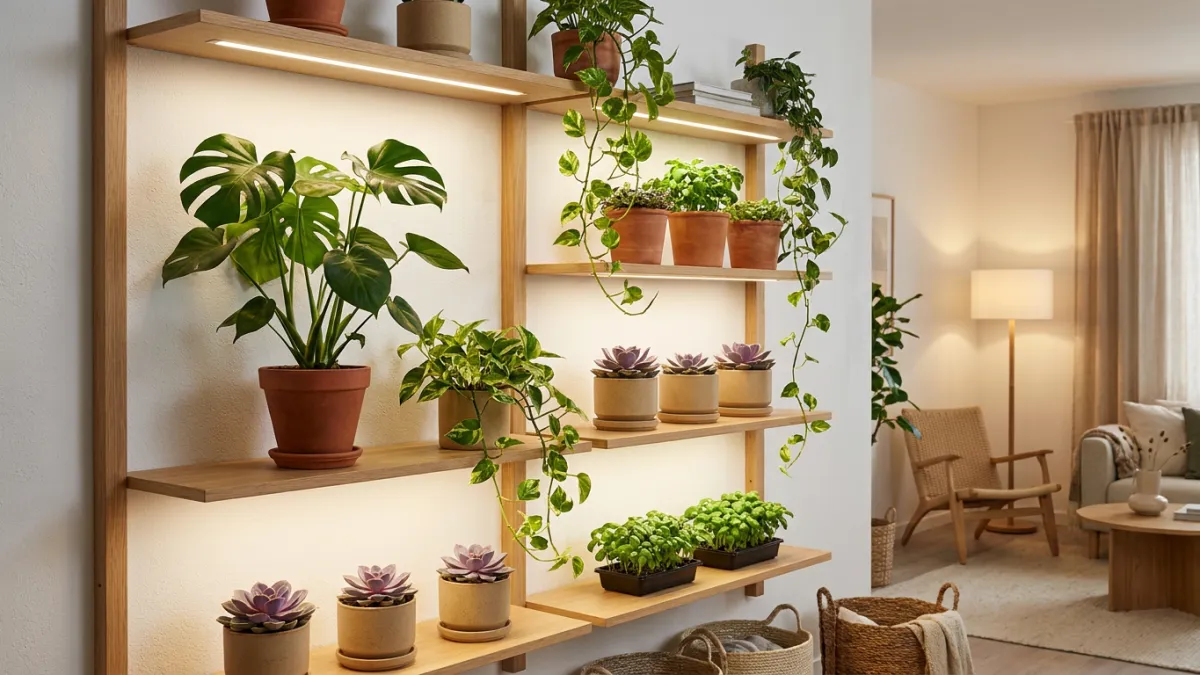
Point-source grow bulbs lose intensity rapidly with distance: doubling the gap between bulb and leaf from 8 inches to 16 inches cuts center-beam PPFD by roughly 65% to 75%! Multi-bar linear T5/T8 LED strips spread photons more evenly across wide shelves (such as an IKEA greenhouse cabinet), typically delivering 160–240 PPFD at 8–10 inches while dropping below 60 PPFD at 22 inches.
Rule of thumb when upgrading lights: Never jump a shade-acclimated houseplant straight from a 50 PPFD hallway to a 350 PPFD grow bulb overnight—its leaves lack protective xanthophyll/anthocyanin sunscreen pigments and will photobleach white! Lower fixture height gradually over 10–14 days, and recalculate hydration in our Watering Calculator because brighter PPFD increases water and fertilizer demand by 30%–50%.
4. Choosing Kelvin Color Temperature & High-CRI White LEDs
- Skip purple ("blurple") red/blue LEDs in living spaces: Modern horticultural Samsung/Bridgelux white diodes outperform cheap red/blue fixtures in watt-for-watt canopy penetration—and more importantly, blurple light masks early chlorosis (yellowing leaves) and thrips or spider mite stippling until infestations turn severe!
- 3500K – 4000K (Neutral Warm White, CRI 90+): Looks like natural morning sunlight in bedrooms and living rooms while providing balanced blue + deep-red wavelengths for houseplants, orchids, and flowering citrus.
- 5000K – 6500K (Cool Daylight): Higher blue-photon fraction (~20%–24% blue) suppresses auxin stem elongation—making it unbeatable for tight, stocky spring seed-starting racks and colorful stress-blushed Echeveria rosettes.
Match Every Shelf & Window to Thriving Species with Leafy AI
Adding grow lights speeds up photosynthesis, water uptake, and nutrient consumption. Track growth photos over time and dial in room-specific watering and feeding reminders inside Leafy AI on Google Play.