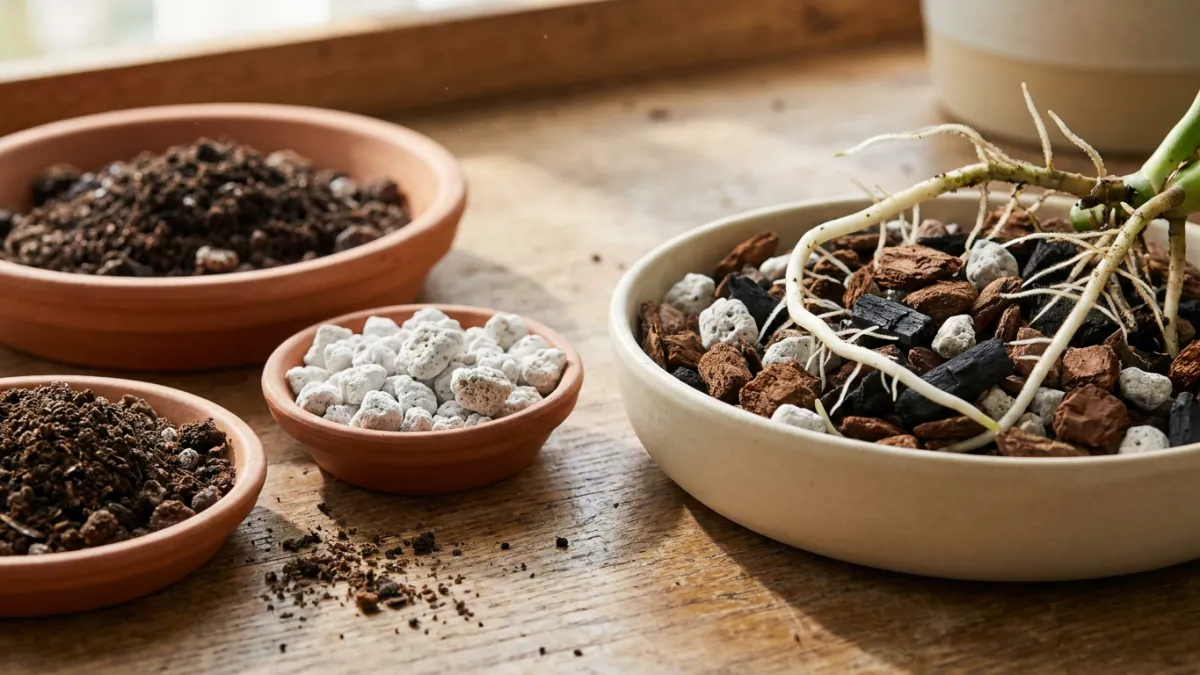
Standard bagged indoor potting soil is mostly sterile peat or fine composted bark that compacts within weeks, starving beneficial aerobic microbes of oxygen and letting anaerobic Pythium root-rot pathogens take over. Building a living container rhizosphere requires four elements: 15%–25% permanent macropores (bark + pumice), humic cation exchange sites (charged biochar + coco coir), active nitrifying bacteria (10% screened worm castings), and low-salt slow feeding that protects root hairs.
Walk down any garden-center aisle and grab a bag of "All-Purpose Indoor Potting Soil." Open it up, water a Monstera Deliciosa or Calathea Orbifolia three times, and watch what happens: fine peat fibers collapse downward, drainage slows to a trickle, sour-smelling anaerobic pockets form at the bottom of the pot, and fungus gnats move into the soggy top inch.
In outdoor garden beds, earthworms, springtails, saprophytic fungi, and nitrifying bacteria continuously rebuild soil aggregates. Inside a 6-inch plastic nursery pot, there are no earthworms commuting from neighboring beds—you are the entire ecosystem architect. Understanding how the container soil microbiome actually functions turns chronic overwatering and mysterious nutrient lockouts into predictable, thriving root systems.
1. Why Sterile Potting Mixes Burn Roots When You Fertilize
Check the guaranteed analysis label on many inexpensive liquid houseplant fertilizers and you will notice most of the nitrogen comes from urea or ammoniacal nitrogen (NH4+) rather than nitrate (NO3−). In living field soil, two guilds of aerobic bacteria—Nitrosomonas and Nitrobacter—rapidly oxidize ammonium into plant-safe nitrate within days.
In heat-pasteurized peat or freshly hydrated coco coir with near-zero bacterial diversity, that conversion stalls. Free ammonium accumulates around tender root tips, dropping rhizosphere pH, burning root hairs, and causing clawing dark leaves or brown leaf edges that plant parents mistake for low humidity. Introducing just 8% to 12% fresh earthworm castings (vermicompost) inoculates the pot with millions of nitrifying bacteria, actinomycetes, and natural plant-growth-promoting rhizobacteria (PGPR) that buffer fertilizer uptake immediately.
2. The Rhizophagy Loop: How Roots "Farm" Soil Bacteria
Roots do not merely sip dissolved mineral ions like passive straws. Through a process plant physiologists call the rhizophagy cycle, growing root tips secrete 15% to 30% of the carbon sugars they manufacture during photosynthesis directly into the surrounding millimeter of soil as root exudates (organic acids, amino acids, and mucilage).
- Recruitment at the root tip: Beneficial bacteria such as Bacillus subtilis and Pseudomonas fluorescens feast on those carbon exudates while unlocking bound iron, calcium, and trace micronutrients from mineral grit.
- Biological pathogen shields: When beneficial aerobic microbes colonize every square millimeter of root epidermis, opportunistic water-mold pathogens (Pythium and Phytophthora, the primary culprits behind indoor root rot) cannot find open attachment sites—provided oxygen stays above 12% in the pore space.
- Fungal nutrient highways: For crops like Tomatoes, Sweet Basil, Dwarf Meyer Lemons, and Roses, pairing bacteria with arbuscular mycorrhizal fungi expands phosphorus and zinc reach up to 10× beyond the root zone (read our deep dive on 12 Research-Backed Facts About Mycorrhizal Fungi).
3. Substrate Physics & Chemistry: Comparing 6 Core Amendments
Microbes need two physical guarantees inside a container: Air-Filled Porosity (AFP) so oxygen diffuses to the bottom of the pot within minutes after watering, and Cation Exchange Capacity (CEC)—negatively charged microscopic surfaces that hold onto positively charged calcium (Ca2+), magnesium (Mg2+), and potassium (K+) ions instead of letting them flush straight down the sink drain.
| Amendment | Air Porosity & Lifespan | CEC (Nutrient Hold) | Microbiome & Root Role |
|---|---|---|---|
| Worm Castings (10%) | Fine humus; cap at 10%–15% indoors so mix stays airy | Very High (150–250 meq/100g) | Primary source of nitrifying bacteria, humic acids, chitinase enzymes (suppresses pest larvae), and gentle slow-release nutrition. |
| Charged Horticultural Biochar (5%–8%) | Permanent rigid honeycomb pores (never decomposes) | High once pre-charged with compost tea/castings | Microscopic coral-reef housing where beneficial bacteria and fungal hyphae survive dry spells between waterings; sweetens acidic peat decay. |
| Chunky Pine / Fir Orchid Bark (25%–35%) | High macropores; breaks down slowly over 18–24 months | Moderate (increases as lignin ages) | Essential structural skeleton for epiphytic aroids (Monstera, Philodendron, Anthurium) that naturally cling to tree bark. |
| Horticultural Pumice vs. Perlite (20%) | Permanent mineral drainage; pumice never floats to top | Low–Moderate (internal micro-vesicles hold trace water) | Creates permanent oxygen channels preventing anaerobic dead zones in deep 8–12 inch pots and Snake Plant / ZZ Plant mixes. |
| Buffered Coco Coir (40%) | Re-wets instantly (never hydrophobic like bone-dry peat) | Moderate (40–70 meq/100g; always use Ca/Mg-buffered coir) | Neutral pH (5.8–6.5) moisture sponge rich in natural Trichoderma fungi that parasitize root-rot molds. |
Want exact liter, quart, and cup measurements tailored to your pot diameter? Plug your pot size into our free Potting Soil Mix & Pot Volume Calculator for instant Aroid, Succulent, Fern, and Container Veggie recipes.
4. Four Everyday Habits That Accidentally Wipe Out Pot Microbes
- Letting moisture-loving pots go bone-dry then drowning them: Extreme desiccation kills active bacterial biofilms, and flooding compacted dry peat afterward traps stale CO2 around weakened roots. Dial in steady species-specific intervals with the Plant Watering Schedule Calculator.
- Over-dosing high-salt synthetic fertilizers: Mixing synthetic salts at full label strength on slow-growing winter houseplants spikes Electrical Conductivity (EC), osmotically dehydrating microbes and causing crispy brown leaf tips.
- Routine hydrogen peroxide drenches on healthy soil: While a one-time diluted 1% H2O2 rescue flush has its place during emergency root-rot surgery, pouring peroxide into healthy pots every month oxidizes beneficial bacteria and mycorrhizae indiscriminately.
- Using unwashed cocoa-shell mulches in pet homes: Keep indoor top-dressings pet-safe (pumice, LECA, or clean bark)—never cocoa-bean hulls, which contain theobromine toxic to dogs and cats (check any plant in our Cat & Dog Pet Toxicity Lookup).
Track Repotting Dates, Soil Health & Feeding in Leafy AI
Even premium pine-bark mixes compact after 18–24 months. Log your pots in Leafy AI on Android for seasonal watering reminders, repotting alerts, and live AI video consultations whenever soil or roots look off.