Relative Humidity (RH %) only tells you how full the air is relative to its temperature—not how hard dry air is pulling water out of your plant's leaves. Vapor Pressure Deficit (VPD, measured in kilopascals, kPa) combines temperature and humidity to measure true atmospheric drying force. Most tropical houseplants thrive between 0.7 and 1.2 kPa (e.g., 55%–65% RH at 72°F / 22°C). Above 1.5 kPa, stomata slam shut, growth stalls, leaf edges crisp, and spider mites breed twice as fast.
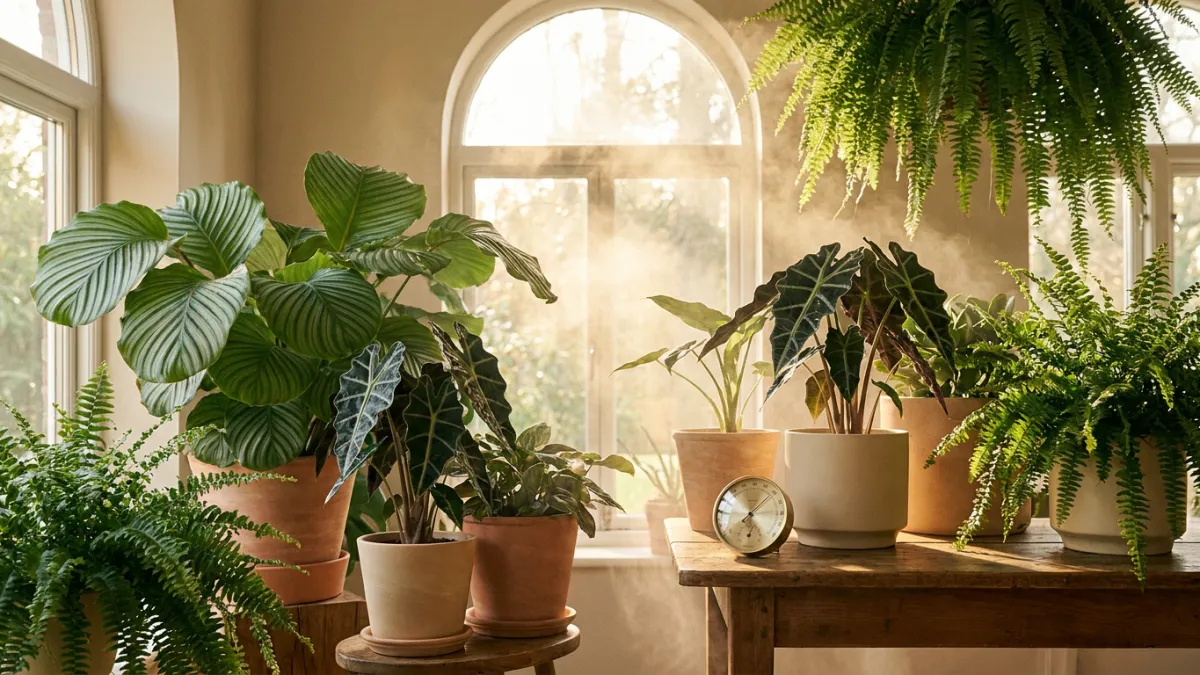
Every houseplant care tag says something vague like "Prefers 50%–60% humidity." Yet any grower who has kept a Calathea Orbifolia, Alocasia Polly, or Boston Fern through both a cool 66°F winter sunroom and an 84°F summer heatwave notices a paradox: at the exact same 50% relative humidity, the cool winter plant stays turgid and glossy while the 84°F plant curls its leaves inward within hours.
Commercial greenhouse engineers solved this mystery decades ago by retiring raw RH % as their primary target and governing climate by Vapor Pressure Deficit (VPD). Understanding VPD takes five minutes and permanently changes how you troubleshoot curling leaves, stalled unfurling, crispy leaf margins, and winter radiator stress.
1. What VPD Actually Measures (Without Heavy Physics)
Inside a healthy hydrated leaf, the microscopic air cavities beneath the stomata (breathing pores) are virtually 100% saturated with water vapor. Outside the leaf, your living room air holds less water vapor. Physics dictates that water molecules diffuse from high vapor pressure (inside the leaf) to lower vapor pressure (your room).
Warm air behaves like a giant sponge: for every ~18°F (10°C) jump in temperature, air's maximum water-holding capacity roughly doubles (governed by the Tetens saturation vapor pressure equation). Consequently, 45% RH at 66°F exerts a gentle, comfortable pull of 1.12 kPa, whereas 45% RH at 84°F exerts an aggressive desert pull of 2.10 kPa—ripping moisture out of foliage faster than fine roots can pump it upward!
2. Indoor Plant VPD Reference Chart (kPa by Room Temp & RH %)
Check an inexpensive digital thermometer/hygrometer placed right at leaf height (not across the room on a wall) and match your reading below, assuming leaf temperature sits ~1°F–2°F cooler than ambient air due to evaporative cooling:
| Room Temp | 30% RH (Dry Winter) | 45% RH (Typical Home) | 60% RH (Tropical Sweet Spot) | 75% RH (Cabinet / Terrarium) |
|---|---|---|---|---|
| 65°F (18.3°C) | 1.40 kPa (Borderline Dry) | 1.09 kPa (Ideal General) | 0.78 kPa (Optimal Tropical) | 0.46 kPa (Cuttings / Ferns) |
| 70°F (21.1°C) | 1.68 kPa (High Stress) | 1.31 kPa (Upper Safe Limit) | 0.94 kPa (Optimal Tropical) | 0.56 kPa (Ideal Rare Aroids) |
| 75°F (23.9°C) | 2.00 kPa (Stomatal Shutdown) | 1.56 kPa (Leaf Curl / Tip Burn) | 1.12 kPa (Peak Growth) | 0.68 kPa (Optimal Tropical) |
| 80°F (26.7°C) | 2.38 kPa (Severe Scorch Risk) | 1.85 kPa (Spider Mite Zone) | 1.33 kPa (Warm Active Limit) | 0.81 kPa (Peak Greenhouse) |
| 85°F (29.4°C) | 2.81 kPa (Extreme Arid Stress) | 2.19 kPa (High Stress) | 1.57 kPa (Needs Extra RH) | 0.96 kPa (Optimal Warm Cabinet) |
3. Matching VPD Zones to Specific Plant Groups
- 0.4 – 0.7 kPa (Propagation & Cloud-Forest Zone): Ideal for unrooted stem nodes without root hairs, nerve plants (Fittonia), Maidenhair Ferns, and freshly imported tropicals inside a sealed IKEA greenhouse cabinet. Below 0.35 kPa without USB fan airflow, transpiration halts and fungal edema or botrytis mold threatens leaves.
- 0.7 – 1.1 kPa (Vegetative Foliage Sweet Spot): Peak stomatal conductance for Monstera Deliciosa, Anthurium, Prayer Plant, Peace Lily, and Phalaenopsis Orchids. New leaves slide smoothly out of cataphyll sheaths without tearing or sticking.
- 0.9 – 1.4 kPa (Fruiting Crops, Herbs & Mediterranean Shrubs): Brisk transpiration drives calcium transport into fast-swelling Tomatoes and Peppers (preventing blossom-end rot!) and keeps powdery mildew off Rosemary and Zucchini.
- 1.6+ kPa (The Danger Zone): Common beside winter forced-air heating vents (73°F at 25% RH = 1.96 kPa!). C3 tropicals close their stomata to avoid lethal wilting, which simultaneously locks out CO2 intake and halts photosynthesis—while two-spotted spider mites cut their egg-to-adult lifecycle from 14 days down to just 5 days in hot, high-VPD air.
4. Practical Fixes: Why Hand-Misting Fails & What Actually Lowers VPD
Controlled hygrometer tests show that spraying a plant with a handheld mist bottle spikes local humidity for 8 to 14 minutes before room air dilutes the vapor back to baseline—leaving mineral tap-water spots and wet leaf axils prone to bacterial crown rot. Instead, use three physics-backed levers:
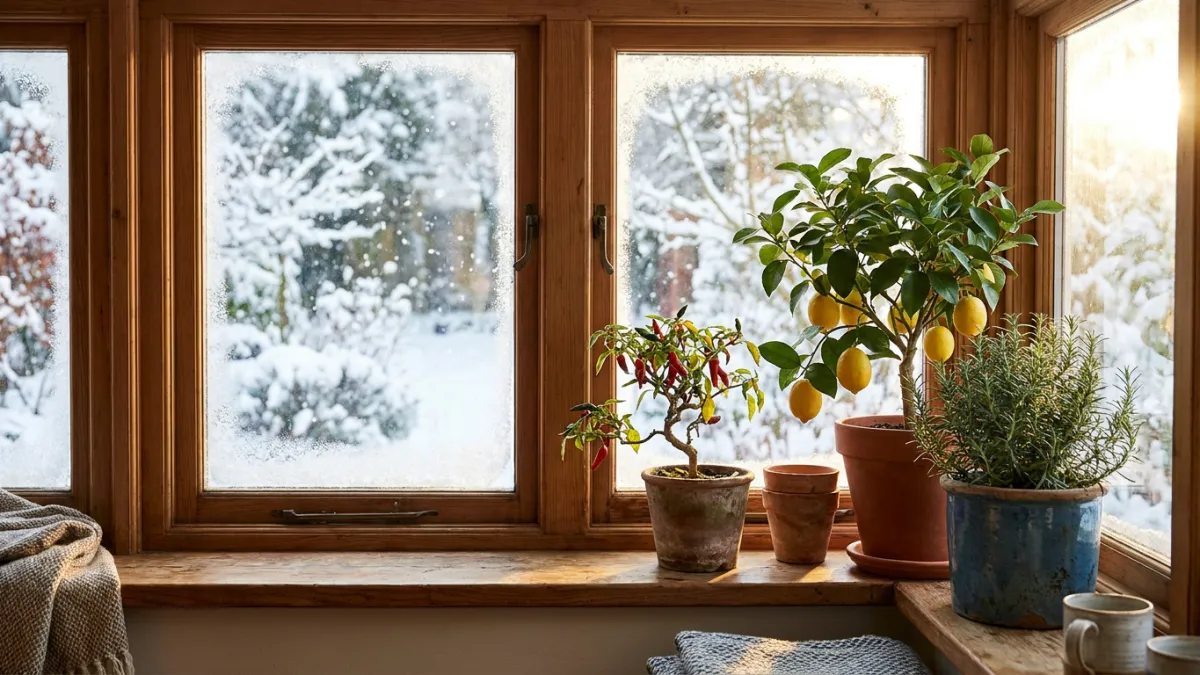
- Drop temperature 3°F–4°F when you cannot raise humidity: Moving a Calathea or Meyer Lemon just 4 feet away from a hot radiator or scorching west glass lowers leaf temperature by 5°F, instantly dropping VPD by ~0.35 kPa without plugging in a humidifier!
- Cluster canopy microclimates: Grouping 6 to 8 leafy plants together merges their transpiring boundary layers, lowering localized leaf-surface VPD by 15%–25%—just remember to keep pots separate to avoid root allelopathy and verify spacing if you have curious pets (browse 100% pet-safe plants).
- Sync watering to seasonal VPD shifts: High summer VPD drains terracotta pots twice as fast, while cool autumn days slow transpiration. Recalculate your pot's exact interval anytime with our Plant Watering Schedule Calculator.
Stuck Leaf, Curling Edges, or Crispy Tips? Show Leafy AI on Live Video
High-VPD humidity stress, fluoride tap-water burn, and early spider mite stippling look remarkably similar in static photos. Start a real-time camera call in Leafy AI on Android to inspect leaf undersides and dial in your room care schedule.